
早知道早瘦,養好代謝!想要快速瘦肚子這篇必看!
有小肚肚好困擾,除了不好穿衣服外,其實過多的腹部脂肪,會增加慢性疾病的風險,像是第二型糖尿病、心臟病等。
瘦肚子沒有什麼難,用對方法就可以!今天整理給大家的是14個超級有效瘦肚肚大法
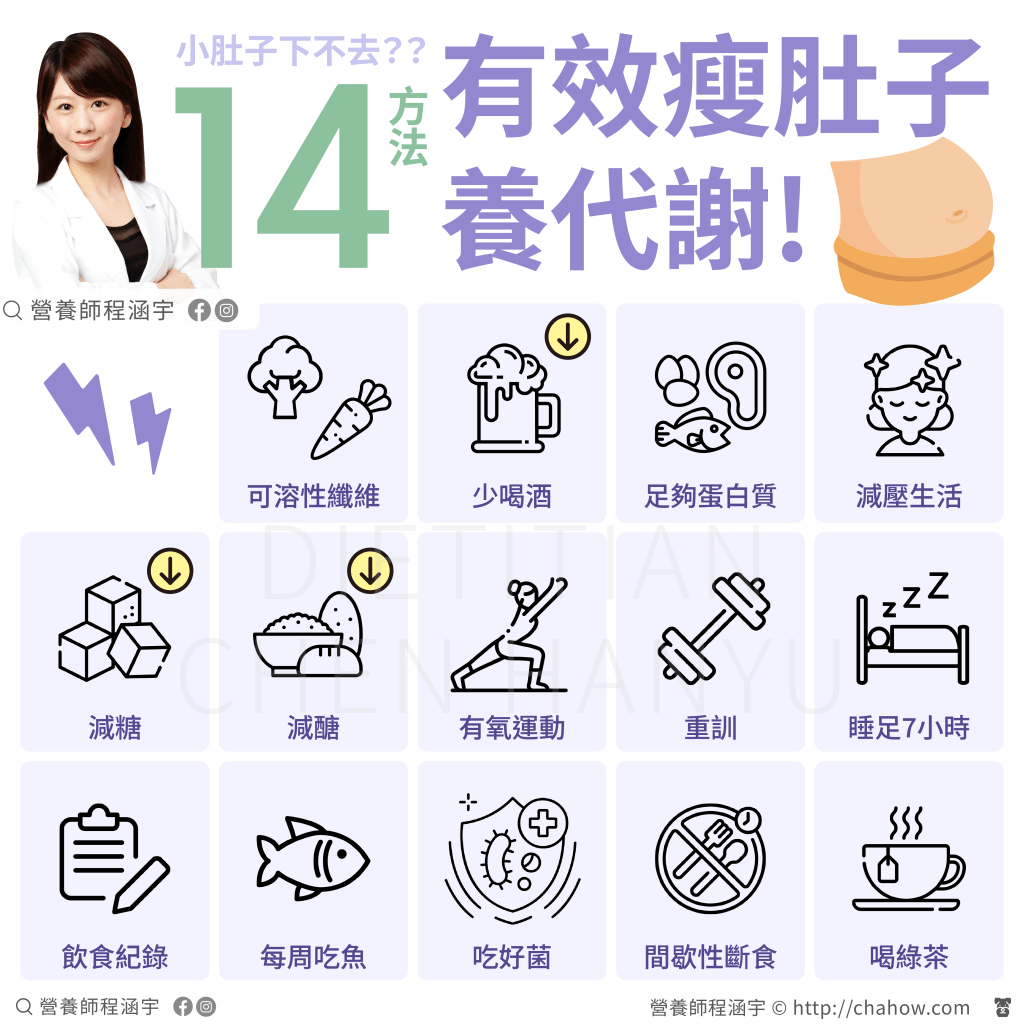
1.攝取足夠的可溶性纖維
可溶性纖維幫助吸收水分增加飽足感,減緩食物消化速度,讓你自自然然的少吃一點,可溶性纖維也可能有助於減少腹部脂肪。
研究在這邊:針對1100多名成年人的觀察性研究發現,每增加10公克可溶性纖維,腹部脂肪就會減少3.7%。
10公克纖維全天均衡組合範例食譜:
早上:一碗燕麥+一湯匙奇亞籽
中午:一碗燙秋葵+酪梨
晚上:一碗木耳菇菇
優秀的可溶性纖維來源包括水果、蔬菜、豆類、燕麥、大麥,建議每天都要吃!
2.適度飲酒 研究發現,過量飲酒會增加腹部脂肪
減少飲酒可能有助於減少腰圍。有人會問說我每天小酌OK嗎?還是平常不喝但一喝就喝很多酒比較不會胖到肚子?
一項2000多人的研究發現*,每天喝點小酒(少於一杯)的人比平不常喝酒但一喝就喝很多的人腹部脂肪更少喔!
3.足夠蛋白質
蛋白質對於體重管理超有幫助!
高蛋白攝取增加飽足荷爾蒙多肽YY(fullness hormone peptide YY)釋放,這可以幫助不亂吃、不會動不動就餓,並增加飽足感。
蛋白質還可以提高新陳代謝率,讓減肥中可以好好維持肌肉質量。
研究發現*,吃較多蛋白質的人往往比吃較少蛋白質飲食的人腹部脂肪更少。
確保每天都有吃好的蛋白質,像是:豆類、魚類、蛋類、肉類、乳品
4.減少壓力
壓力會影響壓力荷爾蒙進而增加腹部脂肪。
較高的壓力荷爾蒙會增加食慾並讓腹部脂肪容易儲存><
5.減糖
高糖與腹部脂肪增加之間是有關係的!也跟心臟病、脂肪肝、第二型糖尿病的發生有關!
6.減醣,特別是精製醣
更好的醣的來源是全穀雜糧有麩皮的那種,像是糙米、黑米、燕麥等,和吃較多精製醣的人比起來,腹部脂肪低17%*
7.有氧運動
有氧運動是讓我們更健康和燃燒熱量的有效方法。
8.重訓
保持和增加肌肉量,對於有脂肪肝的人來說也有助於減少腹部脂肪*。
9.充足的睡眠
研究發現睡眠不足的人更容易胖而且肚肚更容易囤積脂肪!
有一個超過16年的大型女性研究發現,睡眠少於5小時的人比每晚睡眠7小時或更多的人更有可能增加體重*。所以記得每天要睡滿7小時!
10.飲食紀錄
其實有很多方法可以幫助肚肚脂肪變少,利用記錄飲食有助於控制熱量!想要變瘦熱量赤字是關鍵!
11.每週吃魚
高脂肪魚像是鮭魚、鯖魚等對健康非常棒。含有優質蛋白質和omega-3脂肪酸,提升保護力。
12.吃好菌
好菌幫助改善腸道環境,像是Lactobacillus fermentum,Lactobacillus gasseri, Lactobacillus amylovorus先前也有研究發現跟腹部脂肪有關。
13.試試間歇性斷食
像是16/8斷食法。研究發現跟只限制熱量比起來,如果用間歇性斷食搭配一天中定期攝取蛋白質,更可以降低體重、總脂肪,內臟脂肪*也一起降下來。
14.喝綠茶
喝綠茶超棒,市面上也非常好買,記得優先買有標示兒茶素含量的!
綠茶中的咖啡因和兒茶素(EGCG)幫助代謝更順暢。搭配運動對於減少腹部脂肪效果更好*。
小提醒:
建議以上方法至少挑5個同步執行,長期調整飲食、改變生活型態絕對是跟小肚肚說掰掰的關鍵!
祝大家快點把惱人的肚肚瘦下來吧!
Reference
Arciero, Paul J., et al. “Intermittent fasting and protein pacing are superior to caloric restriction for weight and visceral fat loss." Obesity 31 (2023): 139-149.
Hairston, Kristen G., et al. “Lifestyle factors and 5‐year abdominal fat accumulation in a minority cohort: the IRAS family study." Obesity 20.2 (2012): 421-427.
Schröder, Helmut, et al. “Relationship of abdominal obesity with alcohol consumption at population scale." European journal of nutrition 46 (2007): 369-376.
Dorn, Joan M., et al. “Alcohol drinking patterns differentially affect central adiposity as measured by abdominal height in women and men." The Journal of nutrition 133.8 (2003): 2655-2662.
Loenneke, Jeremy P., et al. “Quality protein intake is inversely related with abdominal fat." Nutrition & metabolism 9 (2012): 1-3.
Stanhope, Kimber L., and Peter J. Havel. “Fructose consumption: considerations for future research on its effects on adipose distribution, lipid metabolism, and insulin sensitivity in humans." The Journal of nutrition 139.6 (2009): 1236S-1241S.
McKeown, Nicola M., et al. “Whole-and refined-grain intakes are differentially associated with abdominal visceral and subcutaneous adiposity in healthy adults: the Framingham Heart Study." The American journal of clinical nutrition 92.5 (2010): 1165-1171.
Dutheil, Frédéric, et al. “Different modalities of exercise to reduce visceral fat mass and cardiovascular risk in metabolic syndrome: the RESOLVE* randomized trial." International journal of cardiology 168.4 (2013): 3634-3642.
Salman, Havva Banu, Mehmet Alper Salman, and E. Yildiz Akal. “The effect of omega-3 fatty acid supplementation on weight loss and cognitive function in overweight or obese individuals on weight-loss diet." Nutr Hosp 39.4 (2022): 803-13.
Sanchez, Marina, et al. “Effect of Lactobacillus rhamnosus CGMCC1. 3724 supplementation on weight loss and maintenance in obese men and women." British Journal of Nutrition 111.8 (2014): 1507-1519.
Kadooka, Yukio, et al. “Regulation of abdominal adiposity by probiotics (Lactobacillus gasseri SBT2055) in adults with obese tendencies in a randomized controlled trial." European journal of clinical nutrition 64.6 (2010): 636-643.
Kadooka, Yukio, et al. “Effect of Lactobacillus gasseri SBT2055 in fermented milk on abdominal adiposity in adults in a randomised controlled trial." British Journal of Nutrition 110.9 (2013): 1696-1703.
 營養師程涵宇 Dietitian Han-Yu Chen